
Starke County Felony Records Search
Starke County felony records are maintained by the Starke County Circuit Court Clerk in Knox, the county seat. Located in northern Indiana between LaPorte and Pulaski counties, Starke County routes all felony case filings through its circuit court. You can look up Starke County felony records online at no cost through the Indiana MyCase portal, or you can contact the clerk's office directly for copies of specific case files and certified documents. State law makes most felony case records available to anyone who requests them.
Starke County Felony Records Quick Facts
Starke County Circuit Court Clerk
The Starke County Circuit Court Clerk's office in Knox is the central records office for all felony cases in the county. When a felony charge is filed in Starke County, the clerk receives the paperwork and maintains it throughout the life of the case. The file includes the charging information, all motions and orders, plea documents if applicable, and the final judgment or sentence. Every step of the felony case process is recorded and kept by this office.
| Office | Starke County Circuit Court Clerk |
|---|---|
| Address | 53 E. Mound Street, Knox, IN 46534 |
| Phone | (574) 772-9160 |
| Website | in.gov/courts/local/starke |
Staff at the Starke County clerk's office can search records by defendant name or case number. Plain copies of case documents cost $1.00 per page under Indiana's standard rate. Certified copies, which you would need for formal legal proceedings or background checks, cost $3.00 each. If you are looking for older records that may predate the electronic system, call ahead so staff can check whether those files are in storage and how long a retrieval might take.
Note: Starke County's circuit court handles both felony and misdemeanor cases, so staff manage a broad workload. Calling before visiting can save time.
Find Starke County Felony Records Online
The Indiana MyCase portal at public.courts.in.gov/mycase provides free access to Starke County felony case information. No account is required for a basic name search. You enter a person's name and MyCase returns all cases filed in Indiana courts under that name, including those from Starke County. Each result shows the case number, charges, and current status. This is the starting point most people use when they want to check on a specific case or find out whether someone has a felony record in Starke County.
MyCase shows case summaries and some documents directly on the site. For complete case files or certified copies of court documents, you need to go through the Starke County clerk's office. But for a quick check, MyCase gives you what you need. The Indiana Judicial Branch maintains county-level information for Starke County at in.gov/courts/local/starke, including current court contact details.
Indiana's public records laws that govern access to Starke County felony records are detailed in the Indiana Code. The Indiana State Legislature publishes those statutes at iga.in.gov, where you can look up the full text of Indiana's public access laws.
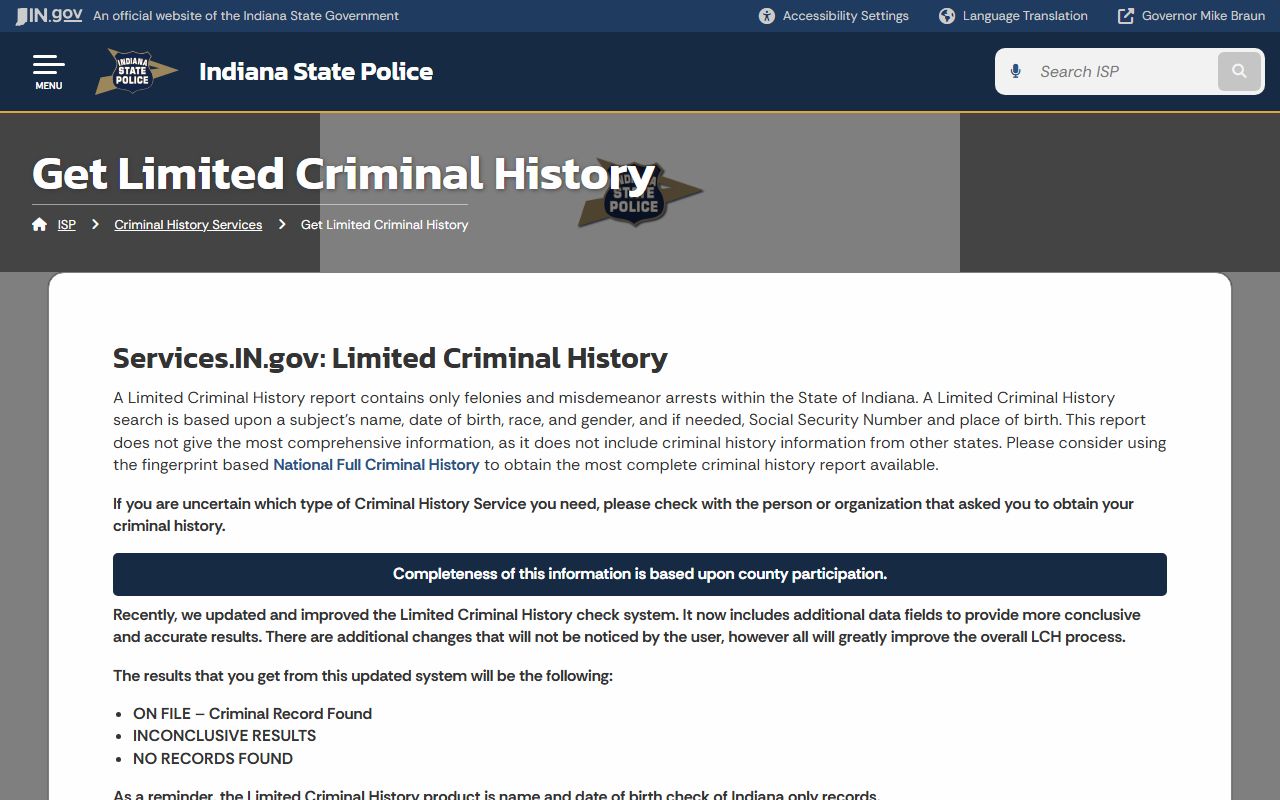
State-level resources like MyCase and the ISP criminal history system are the same tools Starke County residents use to access criminal records, since the county does not maintain a separate public search portal of its own.
Indiana State Police Limited Criminal History
When you need a broader view of someone's criminal record beyond just Starke County, the Indiana State Police Limited Criminal History service is the right tool. The ISP LCH pulls from a statewide database of felony arrests and Class A misdemeanor arrests from all 92 Indiana counties, going back several decades. If someone was arrested for a felony in Starke County five years ago and in Marshall County two years ago, a single LCH search will show both records.
Run the search online at in.gov/ai/appfiles/isp-lch. The cost is $15.70 per name search, paid by credit card. Results are returned quickly. The ISP LCH service is explained in more detail at in.gov/isp/criminal-history-services, including what types of records are included and what the search does not cover.
The ISP LCH and MyCase use different data sources, so running both searches gives you the most complete picture. MyCase is court-based. The ISP LCH is law-enforcement-based. Together they cover the full range of available public felony records for Starke County and statewide.
How Felony Cases Work in Starke County
A felony case in Starke County starts with an arrest by the Starke County Sheriff's Office or a local police department. After booking, the Starke County Prosecutor reviews the case and decides whether to file formal felony charges. If charges are filed, the case goes to the Starke County Circuit Court, where it proceeds through arraignment, pre-trial hearings, and either a trial or a plea. Each step generates court filings that become part of the public record.
Under IC 5-14-3-5, the Starke County Sheriff's Office must make certain records available to the public. Arrest records, daily logs, and warrant information are open to anyone who asks. You do not have to explain why you want them. This law applies to all Indiana sheriffs, including in Starke County.
When someone is convicted of a felony in Starke County and sent to prison, their custody moves to the Indiana Department of Correction. The IDOC tracks all incarcerated individuals statewide. You can look up a person currently in IDOC custody at offenderlocator.idoc.in.gov for free. This search works for anyone sentenced after a Starke County felony conviction as well as convictions from other Indiana counties.
Victims of Starke County felony crimes can sign up for free custody alerts through Indiana's VINE system. VINE sends notifications by phone, text, or email when an offender's custody status changes, whether they are in the Starke County Jail or in an IDOC facility.
Additional Starke County Criminal Records Tools
Indiana's sex offender registry includes individuals convicted of qualifying offenses in Starke County. The registry is searchable by name or location at in.gov/sor. It shows current addresses, photos, and offense details for registered individuals. The Starke County Sheriff's Office is responsible for updating and verifying registrations in the county.
If you have a dispute about access to Starke County felony records, the Indiana Public Access Counselor can help. The PAC at in.gov/pac takes complaints when records are improperly withheld and issues advisory opinions about Indiana's public access laws. Their opinions are published on the website and are a useful reference when you're not sure whether a record should be available.
Legal aid resources in northern Indiana can help Starke County residents navigate the felony records system. Indiana Legal Services provides free help on civil legal issues, including expungement questions and victim rights, for those who qualify.
Expunging Felony Records in Starke County
Indiana law at IC 35-38-9 allows people to petition the court to seal certain felony records after a waiting period. Starke County residents file expungement petitions with the Starke County Circuit Court in Knox. Filing fees are waived under Indiana law, so there is no cost to submit the petition. The process does require that all fines, fees, and restitution from the original case are paid in full before you file.
The waiting period depends on what happened with the case. Arrests that did not result in conviction can qualify after one year in many situations. Felony convictions for less serious offenses generally need eight years from the end of the sentence. More serious felony convictions require ten years and written consent from the Starke County Prosecutor before the court will consider the petition.
Certain offenses cannot be expunged anywhere in Indiana. Homicide, most sex offenses, and other serious violent crimes listed under IC 35-38-9-8.5 are permanently excluded. When a Starke County court grants an expungement, the sealed records come off MyCase and the ISP LCH system, so they no longer appear in public searches.
Note: Expungement in Starke County does not erase the record entirely. Sealed records remain accessible to law enforcement and certain government agencies even after the court order is granted.